
by Joseph
Liquation of Brazing Filler Metals – Good or Bad?
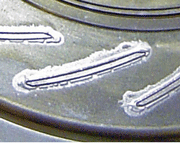 When a brazing filler metal (BFM) is melted during a brazing process, it is not uncommon for “liquation” to occur.
Liquation in brazing is defined as the tendency of the lower-melting constituents of a BFM to separate out and flow away (by capillary action) from the higher-melting constituents of the BFM during heating. Sometimes a non-melted “skull” of alloy remains at the point where the BFM was applied. Liquation is usually apparent in BFMs having a wide melting range, i.e. having a large difference between the solidus and liquidus (Note 1) temperatures. It occurs when the BFM is heated slowly through that melting range (such as when furnace brazing). Liquation is not typically encountered when rapid brazing techniques – flame brazing or induction brazing – are used. By Dan Kay
by Joseph
Repair Brazing – Fixing faulty jobs and worn-out components.
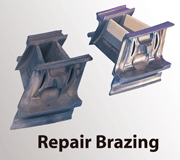 Brazing is a versatile process used in many industries to join materials permanently. Repair brazing is an essential part of the industry and usually is done for one of two reasons – to braze repair parts in-house before they are released to customers and to perform repairs on brazed components that have worn out in service.
The former involves in-house quality assurance programs designed to detect braze defects before they get out the door. The latter involves brazed components worn out from corrosion, erosion, or fatigue (thermal and/or mechanical) in cyclic service, resulting in surfaces that are cracked, pitted, or eroded. By Dan Kay
Next Month: In my next article we will be discussing that when a brazing filler metal (BFM) is melted during a brazing process, it is not uncommon for “liquation” to occur.
by Joseph
Fillets in Brazing
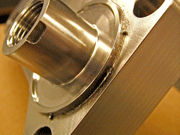
Brazing fillets can be a greatly misunderstood phenomenon in brazing. Some people insist that big fillets are needed, whereas others say that they are not. Let’s take a closer look at fillets in brazing, what they are, what they do and what characteristics about them are desirable.
A braze fillet is actually a casting along the outside of a braze joint that shows that the brazing filler metal (BFM) has melted and flowed along the edge of a braze joint. It doesn’t tell you if the BFM has adequately penetrated the joint, and caution is therefore strongly recommended to anyone attempting to use the many characteristics of a fillet as inspection criteria for judging the overall quality of a braze joint. Fillets are not a significant factor in determining joint strength. What does a fillet do? Fillets, first of all, are a natural outcome of the brazing process and merely give evidence that the BFM has melted and flowed. Fillets can also show whether or not there is good compatibility between the BFM and the base metal, and they may also be able to tell you about base-metal cleanliness. However, strong caution is advised against depending on fillets to be a distributor of stresses. By Dan Kay
by Joseph
Thermocouples in Furnace Brazing – Part 2
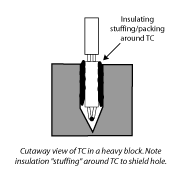 In this month’s article we will look at correct placement of TC’s in furnace brazing loads, and how, together with correct furnace heating/cooling rates, they can help to maximize uniformity of temperature throughout each brazing load and minimize any distortion of the components being brazed. By Dan Kay
Next Month: Next month let’s look at a question that often comes up in furnace brazing, namely, the role of braze-fillets at the edge of brazed joints, and what purpose they actually serve.
by Joseph
Brazing Question Challenge – Differential Metal Expansion Part 1
Did you figure out the answer to Dan’s “Brazing Challenge Question” in his article on Differential Metal Expansion – Part 1 ? The answer is published this month on our website at: “Brazing Question Challenge – Differential Metal Expansion – Part 1 “
by Joseph
Thermocouples in Furnace Brazing – Part 1
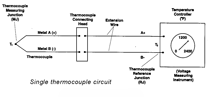 Proper temperature control within each furnace brazing cycle is essential. It will not only insure proper brazing filler metal (BFM) flow, but can also prevent part distortion. To accomplish this, multiple thermocouples (or “TC’s” as they are often called) need to be placed in strategic positions within each furnace load. By Dan Kay
In this first of two articles on TC’s and their use in brazing, I’d like to briefly look at what TC’s are, and the types commonly available for use in brazing furnaces today (much more exhaustive discussions about TC’s can be found on the websites of a number of thermocouple manufacturers and suppliers). In next month’s article, I’ll describe the actual use and placement of these TC’s in different brazing furnace cycles.
Next Month we will look at correct placement of TC’s in furnace brazing loads, and how, together with correct furnace heating/cooling rates, they can help to maximize uniformity of temperature throughout each brazing load and minimize any distortion of components that are being brazed together.
by Joseph
VAC AERO’s Coatings Division Receives Two New NADCAP Approvals.
OAKVILLE, Ontario, (January 8, 2010) – VAC AERO’s Boucherville, Quebec, Canada-based Coatings division recently received two new approvals for coatings and chemical processing. The facility was qualified to the stringent SAE Aerospace Standard AS70003 for Coatings and for Chemical Processing. These two new approvals have now been added to the many other heat treating and…
by Joseph
Differential Metal Expansion – Part 2
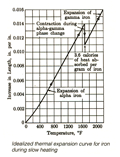 In this month’s article on differential expansion of metals, I will explore the effect that thermal expansion has on joint clearance, and thus, on brazed joint strength and quality of 1018 carbon-steel. For anyone doing high-temperature brazing of carbon-steel components using a high-temperature brazing filler metal (BFM) such as pure copper, it’s an important concept, and needs to be understood. By Dan Kay
Next Month: In my next article, we’ll take a closer look at thermocouples — which kind you should use, and how it should be connected to the parts in your furnace load, where they should be placed in the furnace, etc.
by Joseph
Differential Metal Expansion – Part 1
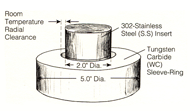 In this article I will explore the effect that thermal expansion has on joint clearance, and thus, on brazed joint strength and quality. It’s an important concept, and although it is well known in the brazing world, many folks today still do not take this topic seriously enough when designing brazed assemblies. This article is based on one I wrote many years ago for an in-house brazing publication at a brazing filler metal supplier, and will be written in two parts. Next month’s segment will look more closely at polymorphic metals, such as carbon steels, and will attempt to explain why they exhibit their very strange thermal expansion curves. By Dan Kay
Next Month: In my next article, I’ll examine the thermal expansion curve for 1018 carbon steel to see why there are strange “reversals” in the thermal expansion curve for that alloy (and for similar metals).
by Joseph
HVOF Spray System
VAC AERO’s high velocity oxygen fuel (HVOF) system based on a new generation carbide jet system. VAC AERO’s Kalisz and Rzeszow plants has installed a fully integrated High Velocity Oxygen Fuel (HVOF) system based on a new generation Carbide Jet System (CJS). The system’s specially designed combustion chamber is fed by hydrogen, kerosene and oxygen…