
by Joseph
Voids in Brazed Joints
 Brazers commonly encounter voids in brazed joints and often wonder where they come from and how to avoid them in future brazements. Some common sources of voids in braze joints are: surface contamination, base metal and brazing filler-metal (BFM) constituents, brazing methods/temperatures used and poor joint fitup. The first three items listed above can often result in gas bubbles being formed in brazed joints. Such gas-bubble voids will usually try to form in spherical shape as they move through a joint. The “rounded” edges of such bubble-voids can often be clearly seen in cross-section photomicrographs of brazed joints, especially under high magnification. The inside surfaces of a bubble-void will often appear “clean” or “shiny” as well. By Dan Kay
by Joseph
VAC AERO Kalisz Installs a New HVOF Spray System
 OAKVILLE, Ontario, (January 11, 2010) – VAC AERO’s Kalisz, Poland-based operation recently installed a fully integrated High Velocity Oxygen Fuel (HVOF) system based on a new generation Carbide Jet System (CJS) produced by Dortmund, Germany-based Thermico.
The system’s specially designed combustion chamber is fed by hydrogen, kerosene and oxygen fuel and optimized for spraying MCrAlY coatings on turbine engine components, tungsten carbide coatings on landing gear components and can perform many other coating applications. Precise combustion and fuel configuration settings control particle temperature and velocity to achieve optimal coating efficiency in less time and lower fuel consumption than other HVOF systems. The system was installed in a 13’X13’X 10’ high (4X4X3 meters) soundproof booth. READ MORE
by Joseph
Braze Joint Design Considerations – Part 2
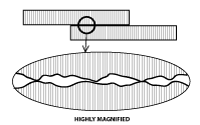 For successful brazing to occur, the joints to be brazed have to be designed properly, and then properly manufactured to attain and maintain those shapes and dimensions. This second article looks at joint clearance considerations in more detail. Joint clearances must be close together and parallel. The amount of clearance between the faying surfaces (the mating surfaces inside a joint being brazed) should ideally be kept small, on the order of about 0.000″– 0.002″ (0.000-0.050 mm) total, so that capillary action can most effectively pull the molten brazing filler metal (BFM) completely into and throughout a braze-joint. By Dan Kay
Next Month: In next month’s article we’ll address some additional factors in joint design, specifically the topic of “differential metal expansion”. All metals expand at different rates when heated, and since braze-joint clearances are calculated based on expected clearances at brazing temperature, we need to know how to properly optimize brazing of different metals in the same assembly.
by Joseph
VAC AERO Completes Plant Re-organization
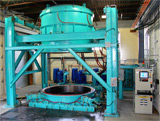 OAKVILLE, Ontario, (December 9, 2009) – VAC AERO’s Oakville Thermal Processing Division recently completed an extensive plant re-organization based on lean and green manufacturing concepts. The project included building renovations to create more production space, the addition of new work-handling and production capacity, safety enhancements and energy efficiency improvements in lighting and power consumption. Lean manufacturing techniques that were implemented in the re-organization included Kanban systems, 5S and visual signals. The company has also been working in close partnership with customers on value stream mapping and smoothing production flow. The effort is already paying benefits. For example, distances travelled for orders within the shop have been reduced on average by 50%. On-time deliveries have improved dramatically, now in many cases being maintained at 100%. VAC AERO invested more than $400,000 in the re-organization, a portion of which was subsidized by a provincial government grant. The completion of the re-organization was timed to coincide with the commissioning of VAC AERO’s fourth large vacuum oil quench furnace, designed and built by the company’s Furnace Manufacturing Division. The new furnace will add significant capacity to the Oakville vacuum oil-quench operation, already one of the largest in the world.
by Joseph
Braze Joint Design Considerations
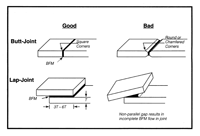 There are basically two types of joint designs used in brazing: butt-joints and lap-joints. All other joint designs are modifications of these two. There are a number of important considerations when designing such joints in order to insure proper service life. This article looks at just a few of those considerations. By Dan Kay
Next Month: Next month I’ll discuss the issue of braze gap clearance for some different base-metal and brazing filler metal (BFM) combinations, and how that affects joint strength and hermeticity. In succeeding months we’ll address issues such as dissimilar metal brazing and how that affects joint design.
by Joseph
VAC AERO Receives Large European Union Grant for Expansion in Poland.
OAKVILLE, Ontario, (October 26, 2009) – VAC AERO International’s Polish subsidiary, VAC AERO Kalisz Sp. z o.o, has been awarded grants totaling 6.4 million PLN (approximately 2.4 million CDN dollars) through the European Union’s New Innovative Investments Program. The grants will support 60% of the company’s investment to establish a new special processes facility in…
by Joseph
How to Determine Braze Gap-Clearances for Your Furnace
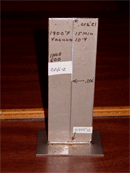 Good brazing depends on the ability of capillary action to draw the molten brazing filler metal (BFM) in all directions throughout the joint being brazed, either vertically or horizontally. A unique Vertical Capillary Test Specimen (VCTS) was developed to help brazers find out the maximum gap-thicknesses that capillary action can fill in their particular brazing furnaces. By Dan Kay
Next Month: Next month I’ll discuss some important design issues regarding braze gap clearances and configurations, and in succeeding months we’ll address issues of dissimilar metal brazing, and joint strength and its optimization in more detail.
by Joseph
VAC AERO Launches Redesigned Website for its 50th Anniversary
For immediate release Oakville, Ontario, September 9, 2009 – VAC AERO International launched its newly redesigned website and a new French version today as part of its 50th anniversary online and print campaign. In addition to featuring concise overviews on its vacuum furnace systems and metallurgical services, VAC AERO offers a host of technical articles…
by Joseph
Maintenance procedures for vacuum furnaces
 Maintenance procedures and safe working conditions are essential in maintaining vacuum furnaces as is proper preparation of components to be heat treated prior to charging to the furnace.
VAC AERO International operates more than a dozen vacuum furnaces in its own heat treating facilities. In addition, it has manufactured hundreds of vacuum furnaces for sale to the global market. Through these activities, the company has gained extensive experience in the care and maintenance of vacuum furnace equipment.
by Joseph
Energy Optimization in the Heat-Treat Department
 Savings can be achieved by improving energy efficiency, which reduces the amount of electricity consumed. Savings can also be easily achieved by making slight changes to the timing of this consumption, thereby reducing the peak electricity demand.
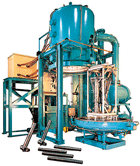
Large heat-treating facilities are substantial electricity consumers. Specializing in vacuum heat treating and brazing for aerospace and other high-technology industries, VAC AERO International’s Oakville, Ontario, plant operates more than 24 vacuum, air and controlled-atmosphere furnaces. Included are three very large vacuum oil-quench furnaces, all of which result in substantial electricity consumption. Indeed, the company’s electricity costs have increased by more than 30% in recent years, thereby driving an effort to find lower-cost solutions. by Mark Passalent