
by Joseph
Are the use of dead-weights for fixturing a recommended practice?
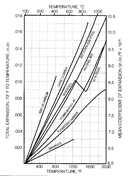 The effective use of “metallurgical fixturing”, instead of a lot of dead-weights, to effectively “load” parts with enough pressure to keep braze joints close together for effective brazing is described in detail.
The use of heavy weights on top of parts being brazed is a common practice. Its purpose is to load the top of the assembly with enough weight so as to insure that the components of the assembly will be pressed together sufficiently to keep the joints from opening up during furnace brazing. This should then insure that good capillary action of the brazing filler metal (BFM) into those joints will occur during the furnace cycle. But in real-life brazing, such use of dead-weights can lead to extended cycle times, and fail to so what it was supposed to do. This article explains why. By Dan Kay
by Joseph
VAC AERO Products & Services
VAC AERO is a leading vacuum furnace manufacturer and metallurgical service provider to aerospace and high-tech industries worldwide. Vacuum Furnace Manufacturing VAC AERO offers a complete line of heat treating and brazing furnaces, from small horizontal laboratory units to large, vertical models. All VAC AERO furnaces come equipped with the Honeywell HC-900 system “hybrid process…
by Joseph
50 Years at a Glance
Yesterday Friday, November 6, 1959: Under the direction of Ross Pritchard the company opens for business as Canadian Vac-Hyd Processing Ltd., a subsidiary of Detroit, Michigan-based Vac-Hyd Processing Corporation. With two employees, the company provides atmosphere heat treating services to the local aerospace industry from a 2,500 sq. ft. leased facility in Oakville, Ontario, Canada….
by Joseph
Privacy Policy
Security and Privacy Notice Security Notice Unauthorized attempts to defeat or circumvent security features, to use the system for other than intended purposes, to deny service to authorized users, to access, obtain, alter, damage or destroy information, or otherwise to interfere with the system or its operation is prohibited. Evidence of such acts may be…
by Joseph
Terms and Conditions of Use
COPYRIGHT AND TRADEMARK NOTICE All materials published or otherwise accessible through VAC AERO, including, but not limited to, copy, text, photographs, images, illustrations, product specs, and other material or content are protected by copyright, and are owned and controlled by VAC AERO. All visitors shall abide by all additional copyright notices, information and restrictions contained…
by Joseph
Coatings
Specialty coating services to the aerospace and high-tech industries include; plasma and high velocity Oxy-fuel (HVOF) spray coatings as well as inorganic paint and pack coatings. VAC AERO’s Canadian plant is located in the heart of Montreal, Quebec aerospace community. Two facilities are now operating in Poland, Kalisz which was established in 2003 and a…
by Joseph
VAC AERO’s Corporate Management moves into New Head Office.
 OAKVILLE, Ontario, (June 29, 2009)
VAC AERO has relocated its Corporate Head Office to 5420 North Service Road, Suite 205 in Burlington, Ontario. An integral part of our Thermal Processing Division’s Lean Manufacturing inspired re-organization plan requires moving our accounting, administration and executive management offices out of our production facility to free up needed plant space. The new offices are located 9 kms (5.5 miles) away from the Thermal Processing and Furnace Manufacturing facilities. The move does not involve any changes to our telephone numbers, mailing address or other contact coordinates.
by Joseph
Selecting Brazing Fixture Materials
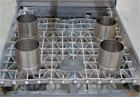 Which base-metal should I use for braze fixturing so that it will last the longest?
This question is not an uncommon one. Although I have never personally seen any kind of chart showing an “expected life” for fixture materials, it is important that people understand that there are a number of factors that will control the “life expectancy” of any fixturing material used in brazing, and all of these factors relate to the service conditions that the fixtures will encounter during the brazing process. By Dan Kay.
In August’s article, I’ll address the commonly used method of adding a lot of “dead weight” onto parts in an attempt to keep them flat during brazing!
by Joseph
Partial Pressure Brazing
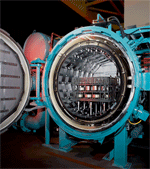 As mentioned in previous articles, more and more brazing shops are using vacuum furnaces. These furnaces are quite complex, offering more options for heating, cooling, partial pressure, or multi-bar pressure (pressure capabilities above one atmosphere) for high-speed cooling.
The overall effectiveness of the equipment, however, still lies with the people who program and run the furnaces. Figure 1 (below) shows a series of vapor pressure curves for a number of common metallic elements. Each curve shows the melting point of the element (indicated by a small circle along the curve) and, where the curve crosses the dotted line across the top of the chart, its approximate boiling point (where it wants to turn to a gas) at one standard atmosphere. By Dan Kay
by Joseph
Brazing in a vacuum “Atmosphere”
 All metals want to react with oxygen as the metals are heated. The higher the temperature, the greater the thermodynamic driving force to have those oxides form. This is true for all metals, even though the oxides of some metals are not as stable as the oxides of other metals. Gold and nickel are examples of metals whose oxides are not stable at any temperature we would encounter in our daily activities, and thus, do not concern us at all. Copper oxides and iron oxides are examples of metals whose oxides are not stable at higher temperatures, in that those oxides are easily and quickly dissociated at elevated temperatures. Chromium-oxide, however, is an example of a fairly stable oxide (up to about 1850F/1000C before dissociating in a typical brazing atmosphere furnace), whereas aluminum-oxide will be extremely stable in a brazing furnace, and is beyond the capability of any standard brazing atmosphere to reduce that oxide. Titanium-oxides behave in a very similar fashion to aluminum oxides in typical brazing furnace atmospheres. By Dan Kay
In June’s article, we’ll look at how creating “partial-pressures” in vacuum furnaces by back-filling vacuum furnaces with an inert atmosphere is sometimes necessary to achieve successful brazements!