
by Joseph
By Dan Kay
 |
|
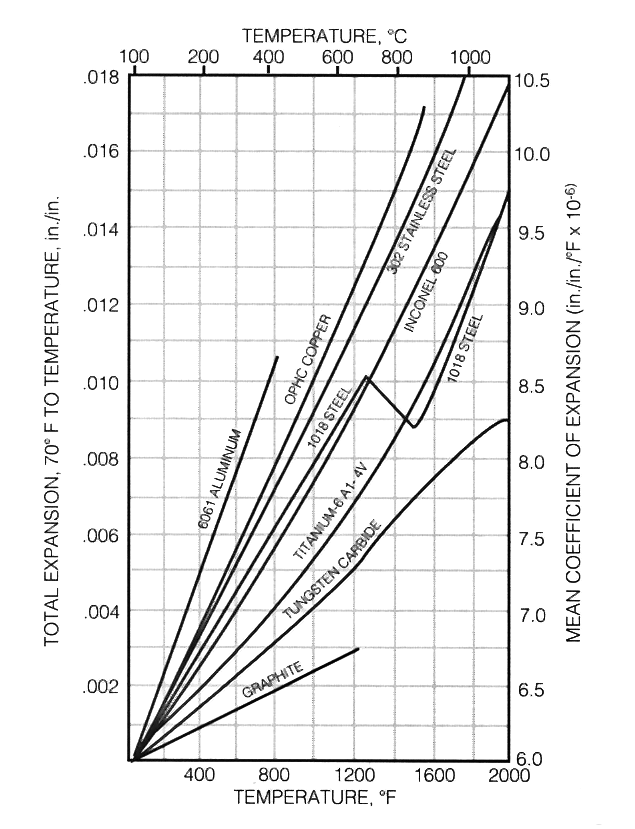
Fig. 1 – Thermal Expansion Curves for several metals
|
In this month’s article on differential expansion of metals, I will explore the effect that thermal expansion has on joint clearance, and thus, on brazed joint strength and quality of 1018 carbon-steel. For anyone doing high-temperature brazing of carbon-steel components using a high-temperature brazing filler metal (BFM) such as pure copper, it’s an important concept, and needs to be understood.
As mentioned in last month’s article, ALL metals expand when they are heated, and contract when they cooled. Fig.1 at right once again shows typical thermal expansion data for some common base metals, indicating that different metals expand at different rates when heated. This month let’s look at the center curve, the one for 1018 carbon steel. Please note that it contains a strange “break” in the curve, and seems to show that the 1018 steel is actually shrinking while it is being heated. Is this true? Yes, this will actually happen.
 |
|
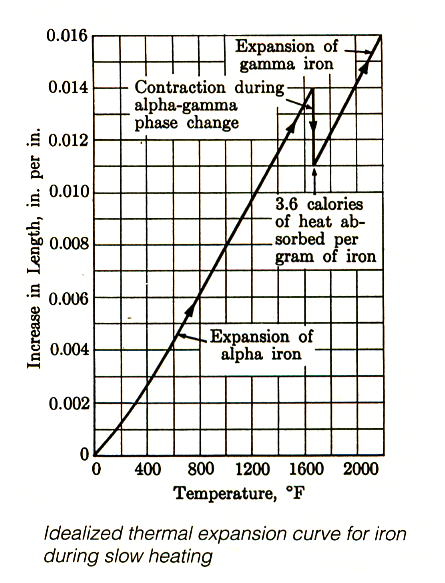
Fig. 2 – Idealized thermal expansion curve for iron during very slow heating (source: see footnote 1)
|
In a laboratory setting, under very carefully controlled conditions, with very slow heating, this “hiccup” in the curve for 1018 steel actually takes place at one temperature, as shown in Fig. 2 at left. But, in production brazing, where heating and cooling is much more rapid, this “hiccup” in the 1018-steel curve occurs over a temperature range from approximately 1200-1500 F (700-850C), as shown above in Fig. 1. Similar curves, i.e., expansion curves showing these “hiccups” during heating, will be seen for many different iron-bearing metals, including 4130 steel, and even 17-4PH, as examples.
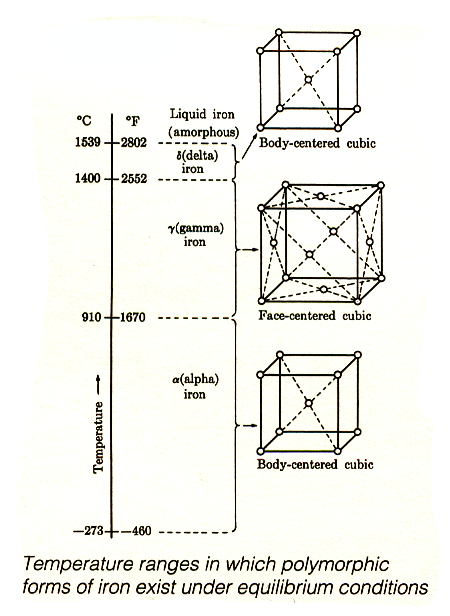
To understand this unusual expansion/contraction phenomenon, we need to look at the actual arrangement of atoms within the metal. In general, metals tend to form very symmetrical, densely packed crystal structures. Two of the most common types of regularly repeating crystal lattice structures are known as “body-centered cubic” (BCC) and “face-centered cubic” (FCC), using nomenclature many of you may remember from the past.
Metals such as iron (and thus carbon steels) have a unique property called “polymorphism”, which, simply put, means that the metal can exist in alternate crystal forms, depending on the temperature and pressure being applied to it. The alpha-iron phase in 1018 steel is BCC at room temperature, but changes to gamma-iron (austenite), which has an FCC crystal structure, when heated to just above 1300F (710C), as shown in Fig. 3 below.
While changing from a BCC to an FCC crystal structure during heating, two things occur that cause shrinkage of the metal lattice structure: (1) heat is absorbed during the phase change, and (2) the packing of atoms becomes more efficient in FCC, allowing more iron atoms to fit in a given space than in the BCC alignment. Once the phase change has been completed, further heating will once again cause the steel to expand. The opposite reactions occur when the steel is cooled.
 |
|
Fig. 3 Change of iron’s crystal structure during heating (source: see footnote 2)
|
These seemingly insignificant “reversals” in thermal expansion and contraction curves for alloys such as 1018 steel can lead to major distortion problems (and even scrapped parts) if these changes are not taken into account during the furnace brazing cycle! For example, suppose you were brazing 1018 steel to an Inconel® 600 component. As you heated the assembly above approximately 1250F (675C), the 1018 steel would begin to shrink, as it started to realign its internal structure from BCC to FCC, while the Inconel would continue to expand almost linearly during that same time. As long as the parts were free to move relative to each other, you might not notice a problem. However, suppose the parts were tack-welded prior to brazing. When the assembly exceeds about 1250F (675C) and the Inconel continues to expand while the 1018 steel shrinks, either the tack-welds may break apart (losing part alignment), or the 1018 tubing may be forced to yield (stretch). This could then result in the tube buckling (distortion) at brazing temperature and also upon cooling.
To prevent this situation from becoming a problem when you are brazing assemblies that contain polymorphic materials, we recommend the following: (1) thermocouple the assemblies adequately so that you can accurately monitor the temperature of the different base metal components during heating, including that of the thinnest and thickest cross-sections; (2) include a built-in “hold” into your programmed furnace cycle at the beginning of the transition zones on both heating and cooling, in order to allow all parts “equalize”, i.e., to achieve thermal equilibrium, before proceeding further; and (3) move through the transition zones very slowly, monitoring your thermocouples for thermal equilibrium. This may add extra time to your furnace cycle, yet it can make the difference between producing good parts, or scrap!
Problem from last month, that readers have yet to solve:
What room temperature radial clearance should be used for the carbide-stainless combination shown in Fig.2 of last month’s article if that combo were going to be brazed at 1950F (1065C) in a vacuum furnace, and a 0.0015″ (0.040 mm) radial clearance was desired at brazing temperature?
Next Month: In my next article, we’ll take a closer look at thermocouples — which kind you should use, and how it should be connected to the parts in your furnace load, where they should be placed in the furnace, etc.
Footnotes:
1 Guy, Elements of Physical Metallurgy, 2nd ed. (MA, Addison-Wesley, 1959), p. 135, Fig. 5.6
2 Guy, Elements…, op.cit., p. 277, Fig. 7.17

Dan Kay – Tel: (860) 651-5595 – Dan Kay operates his own brazing consulting/training company, and has been involved full-time in brazing for 35-years. Dan regularly consults in areas of vacuum and atmosphere brazing, as well as in torch (flame) and induction brazing. His brazing seminars, held a number of times each year help people learn how to apply the fundamentals of brazing to improve their productivity and lower their costs. Dan can be reached via e-mail at dan@kaybrazing.com, and his website can be visited at: http://www.kaybrazing.com/
To View a listing of all Dan’s articles please click here
Read Dan Kay’s Biography
© Copyright Dan Kay 2010