vacuum brazing furnaces Archive

by Joseph
Metallography with George Vander Voort
Metallography with George Vander Voort Conducting the Failure Examination Failures in metallic components may be caused by any of the following factors or combinations of factors: Design shortcomings, imperfections due to faulty processing or fabrication, overloading and other service abuses, improper maintenance and repair and environmental factors. Not all failures are catastrophic. Many failures involve…
by Joseph
Vacuum Technology with The Heat Treat Doctor
Vacuum Technology with “The Heat Treat Doctor” Metallurgy for the Vacuum Heat Treater The role of materials science is to study, develop, design, and perform processes that transform raw materials into useful engineering products intended to improve the quality of our lives. It is said by many that material science is the foundation upon which…
by Joseph
Vacuum Brazing with Dan Kay
Vacuum Brazing with Dan Kay Stress Concentration Don’t Blame the Braze because Joint was Poorly Designed, and NO, larger fillets won’t compensate for that! Have you ever heard someone tell you something like this: “Well, brazing may be okay, but if you really want a strong joint, you should weld it!” Such comments are often…
by Joseph
VAC AERO News & Information
VAC AERO News, Education & Training Kay & Associates Brazing Seminars Since brazing plays an important part in your company’s products, plan to have your staff attend one of the high-powered, three-day seminars being held in 2016. Our Brazing Seminars cover all the essentials for successful brazing of commercial and aerospace components. The improvements to…
by Joseph
Brazing Base Metals Containing Small Amounts of Titanium, Aluminum
 When nickel brazing Inconel 718 base metals in a vacuum furnace some of the difficulties experienced with the brazing include base metals that come out of the furnace dark and discolored, and the brazing filler metal doesn’t wet the surfaces well. In this article we will explain why this is happening, and what can be done about it?
This is not an uncommon problem with a variety of base metals containing small amounts of titanium and/or aluminum. Both titanium and aluminum will easily oxidize, and once those oxides are formed they cannot be easily removed in a standard vacuum-furnace atmosphere. Yes, vacuum is an “atmosphere” in normal production environments since the level of vacuum in the furnace during typical brazing is such that there is, relatively speaking, a goodly number of air molecules still in the furnace, including moisture in that air. Of course, moisture represents the presence of oxygen, which can indeed react with either titanium or aluminum to form very tenacious titanium oxides and aluminum oxides on the surface of the base metal, which will inhibit or prevent brazing filler metal (BFM) flow. By Dan Kay
by Joseph
Vertical Test Specimen for Furnace Brazing
 Furnace brazing is a common brazing process around the world, and I have witnessed many brazing furnaces in action in many countries – from here to mainland China. Furnaces are convenient for brazing since the parts to be brazed can be easily loaded into a batch furnace or onto the belt of a continuous-belt furnace. The operator depends on the various furnace parameters (temperature, time, ramp rates, atmosphere controls, etc.) to ensure that the job of brazing each component will be done reliably, correctly and identically for each part that is subjected to those brazing cycles in that furnace.
An interesting question I have often encountered over the years with furnace brazers is this: “How do I know if a particular gap-clearance will work in my brazing furnace?” Please understand that each brazing furnace is unique and behaves in its own unique way. By this, I mean that even two furnaces of the same model number are not actually identical. Each one has its own personality, and the furnace operator needs to try to understand and work with each “personality.” By Dan Kay
by Joseph
Reducing Metal-Oxides in Brazing – Part 2
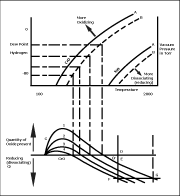 Let me make two important statements right at the start: 1. Surface-oxidation of metals will prevent effective brazing. 2. Brazing filler metals (BFMs) do not like to bond to, or flow over, oils, dirt, greases, or oxides on metal surfaces.
Thus, if any of the surface contaminants just mentioned are present on the metal surfaces to be brazed, effective brazing will not occur. Surface-oxidation is a common source of problems in commercial brazing. Parts to be brazed must be cleaned BEFORE assembling the parts for brazing, and then must be kept clean during the brazing process. One very effective tool that brazing engineers and shop personnel must understand and learn to use is the famous “Metal / Metal-Oxide Equilibrium Curves” published in 1970 in the AWS Welding Journal. By Dan Kay
by Joseph
Reducing Metal-Oxides in Brazing – Part 1
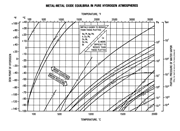 Let me make two important statements right at the start: 1. Surface-oxidation of metals will prevent effective brazing. 2. Brazing filler metals (BFMs) do not like to bond to, or flow over, oils, dirt, greases, or oxides on metal surfaces.
Thus, if any of the surface contaminants just mentioned are present on the metal surfaces to be brazed, effective brazing will not occur. Effective brazing requires the BFM to be able to alloy with (i.e., diffuse into) the base-metal being joined in order to form a strong, leak-tight metallurgical bond. The amount of alloying required is not large, e.g., copper BFM on steel actually alloys/diffuses much less than 5% and yet forms very strong, leak-tight brazed joints on steel. By Dan Kay
Next Month: In next month’s Part-2 article, we will look further into the interpretation and use of the metal/metal-oxide equilibrium-curves shown in Fig. 1, and describe a bit more about the oxidation/reduction reactions that may be occurring inside the brazing furnace throughout the brazing cycle.
by Joseph
Honeycomb-Brazing Essentials for Successful Use As Turbine Seals
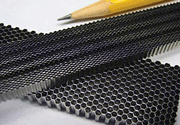 A honeycomb structure serves as an excellent gas flow seal and a sacrificial wear-surface to rotating turbine blades in high-temperature turbines. Achieving the ideal honeycomb construction requires careful attention to the amount and placement of brazing filler metal and brazing time and temperature.
Honeycomb structures, one of nature’s unique designs, are widely used in such diverse applications as automotive, packaging, high-pressure containers, lightweight aerospace wing panels and engine nacelles, and high-temperature turbine seals for ground power and aircraft jet engines, taking advantage of honeycomb’s high structural strength with minimum weight. In the gas-turbine industry, honeycomb is used primarily in shaft-type labyrinth seals and rotating (rotor) blade shroud seals. This article focuses on the latter, and more specifically, on the use of open-face metallic honeycomb structures in high-temperature gas-turbine seal applications in aircraft jet engines and in industrial ground-power gas/steam applications. By Dan Kay
by Joseph
Liquation of Brazing Filler Metals – Good or Bad?
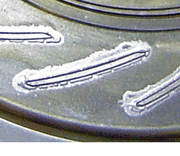 When a brazing filler metal (BFM) is melted during a brazing process, it is not uncommon for “liquation” to occur.
Liquation in brazing is defined as the tendency of the lower-melting constituents of a BFM to separate out and flow away (by capillary action) from the higher-melting constituents of the BFM during heating. Sometimes a non-melted “skull” of alloy remains at the point where the BFM was applied. Liquation is usually apparent in BFMs having a wide melting range, i.e. having a large difference between the solidus and liquidus (Note 1) temperatures. It occurs when the BFM is heated slowly through that melting range (such as when furnace brazing). Liquation is not typically encountered when rapid brazing techniques – flame brazing or induction brazing – are used. By Dan Kay