vacuum brazing furnace Archive

by Joseph
Vertical Test Specimen for Furnace Brazing
 Furnace brazing is a common brazing process around the world, and I have witnessed many brazing furnaces in action in many countries – from here to mainland China. Furnaces are convenient for brazing since the parts to be brazed can be easily loaded into a batch furnace or onto the belt of a continuous-belt furnace. The operator depends on the various furnace parameters (temperature, time, ramp rates, atmosphere controls, etc.) to ensure that the job of brazing each component will be done reliably, correctly and identically for each part that is subjected to those brazing cycles in that furnace.
An interesting question I have often encountered over the years with furnace brazers is this: “How do I know if a particular gap-clearance will work in my brazing furnace?” Please understand that each brazing furnace is unique and behaves in its own unique way. By this, I mean that even two furnaces of the same model number are not actually identical. Each one has its own personality, and the furnace operator needs to try to understand and work with each “personality.” By Dan Kay
by Joseph
Reducing Metal-Oxides in Brazing – Part 2
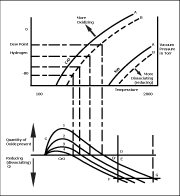 Let me make two important statements right at the start: 1. Surface-oxidation of metals will prevent effective brazing. 2. Brazing filler metals (BFMs) do not like to bond to, or flow over, oils, dirt, greases, or oxides on metal surfaces.
Thus, if any of the surface contaminants just mentioned are present on the metal surfaces to be brazed, effective brazing will not occur. Surface-oxidation is a common source of problems in commercial brazing. Parts to be brazed must be cleaned BEFORE assembling the parts for brazing, and then must be kept clean during the brazing process. One very effective tool that brazing engineers and shop personnel must understand and learn to use is the famous “Metal / Metal-Oxide Equilibrium Curves” published in 1970 in the AWS Welding Journal. By Dan Kay
by Joseph
Reducing Metal-Oxides in Brazing – Part 1
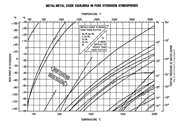 Let me make two important statements right at the start: 1. Surface-oxidation of metals will prevent effective brazing. 2. Brazing filler metals (BFMs) do not like to bond to, or flow over, oils, dirt, greases, or oxides on metal surfaces.
Thus, if any of the surface contaminants just mentioned are present on the metal surfaces to be brazed, effective brazing will not occur. Effective brazing requires the BFM to be able to alloy with (i.e., diffuse into) the base-metal being joined in order to form a strong, leak-tight metallurgical bond. The amount of alloying required is not large, e.g., copper BFM on steel actually alloys/diffuses much less than 5% and yet forms very strong, leak-tight brazed joints on steel. By Dan Kay
Next Month: In next month’s Part-2 article, we will look further into the interpretation and use of the metal/metal-oxide equilibrium-curves shown in Fig. 1, and describe a bit more about the oxidation/reduction reactions that may be occurring inside the brazing furnace throughout the brazing cycle.
by Joseph
Honeycomb-Brazing Essentials for Successful Use As Turbine Seals
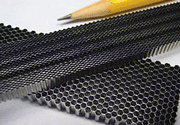 A honeycomb structure serves as an excellent gas flow seal and a sacrificial wear-surface to rotating turbine blades in high-temperature turbines. Achieving the ideal honeycomb construction requires careful attention to the amount and placement of brazing filler metal and brazing time and temperature.
Honeycomb structures, one of nature’s unique designs, are widely used in such diverse applications as automotive, packaging, high-pressure containers, lightweight aerospace wing panels and engine nacelles, and high-temperature turbine seals for ground power and aircraft jet engines, taking advantage of honeycomb’s high structural strength with minimum weight. In the gas-turbine industry, honeycomb is used primarily in shaft-type labyrinth seals and rotating (rotor) blade shroud seals. This article focuses on the latter, and more specifically, on the use of open-face metallic honeycomb structures in high-temperature gas-turbine seal applications in aircraft jet engines and in industrial ground-power gas/steam applications. By Dan Kay
by Joseph
Liquation of Brazing Filler Metals – Good or Bad?
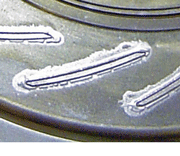 When a brazing filler metal (BFM) is melted during a brazing process, it is not uncommon for “liquation” to occur.
Liquation in brazing is defined as the tendency of the lower-melting constituents of a BFM to separate out and flow away (by capillary action) from the higher-melting constituents of the BFM during heating. Sometimes a non-melted “skull” of alloy remains at the point where the BFM was applied. Liquation is usually apparent in BFMs having a wide melting range, i.e. having a large difference between the solidus and liquidus (Note 1) temperatures. It occurs when the BFM is heated slowly through that melting range (such as when furnace brazing). Liquation is not typically encountered when rapid brazing techniques – flame brazing or induction brazing – are used. By Dan Kay
by Joseph
Repair Brazing – Fixing faulty jobs and worn-out components.
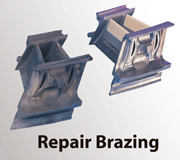 Brazing is a versatile process used in many industries to join materials permanently. Repair brazing is an essential part of the industry and usually is done for one of two reasons – to braze repair parts in-house before they are released to customers and to perform repairs on brazed components that have worn out in service.
The former involves in-house quality assurance programs designed to detect braze defects before they get out the door. The latter involves brazed components worn out from corrosion, erosion, or fatigue (thermal and/or mechanical) in cyclic service, resulting in surfaces that are cracked, pitted, or eroded. By Dan Kay
Next Month: In my next article we will be discussing that when a brazing filler metal (BFM) is melted during a brazing process, it is not uncommon for “liquation” to occur.
by Joseph
Fillets in Brazing
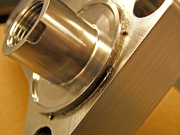
Brazing fillets can be a greatly misunderstood phenomenon in brazing. Some people insist that big fillets are needed, whereas others say that they are not. Let’s take a closer look at fillets in brazing, what they are, what they do and what characteristics about them are desirable.
A braze fillet is actually a casting along the outside of a braze joint that shows that the brazing filler metal (BFM) has melted and flowed along the edge of a braze joint. It doesn’t tell you if the BFM has adequately penetrated the joint, and caution is therefore strongly recommended to anyone attempting to use the many characteristics of a fillet as inspection criteria for judging the overall quality of a braze joint. Fillets are not a significant factor in determining joint strength. What does a fillet do? Fillets, first of all, are a natural outcome of the brazing process and merely give evidence that the BFM has melted and flowed. Fillets can also show whether or not there is good compatibility between the BFM and the base metal, and they may also be able to tell you about base-metal cleanliness. However, strong caution is advised against depending on fillets to be a distributor of stresses. By Dan Kay
by Joseph
Thermocouples in Furnace Brazing – Part 2
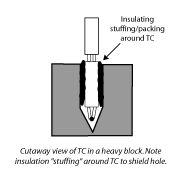 In this month’s article we will look at correct placement of TC’s in furnace brazing loads, and how, together with correct furnace heating/cooling rates, they can help to maximize uniformity of temperature throughout each brazing load and minimize any distortion of the components being brazed. By Dan Kay
Next Month: Next month let’s look at a question that often comes up in furnace brazing, namely, the role of braze-fillets at the edge of brazed joints, and what purpose they actually serve.
by Joseph
Celebrating 50 Years of Industry Leadership
This year marks the golden anniversary of VAC AERO – your global innovative materials solutions provider – an anniversary notable for the many advances we’ve made and continue to make for the growth of our business – and yours. Service Excellence Is the Backbone of Our Reputation. With seven plants on three continents, VAC AERO’s…
by Joseph
Glossary – Z
A B C D E F G H I J K L M N O P Q R Sa-Sq St-Sy T U V W X Y Z zinc worms Surface imperfections, characteristic of high-zinc brass castings, that occur when zinc vapor condenses at the mold/metal interface, where it is oxidized and then becomes entrapped in…