vacuum brazing furnaces Archive

by Joseph
Repair Brazing – Fixing faulty jobs and worn-out components.
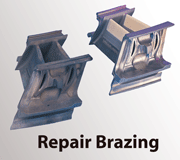 Brazing is a versatile process used in many industries to join materials permanently. Repair brazing is an essential part of the industry and usually is done for one of two reasons – to braze repair parts in-house before they are released to customers and to perform repairs on brazed components that have worn out in service.
The former involves in-house quality assurance programs designed to detect braze defects before they get out the door. The latter involves brazed components worn out from corrosion, erosion, or fatigue (thermal and/or mechanical) in cyclic service, resulting in surfaces that are cracked, pitted, or eroded. By Dan Kay
Next Month: In my next article we will be discussing that when a brazing filler metal (BFM) is melted during a brazing process, it is not uncommon for “liquation” to occur.
by Joseph
Fillets in Brazing
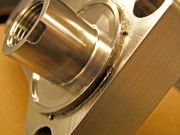
Brazing fillets can be a greatly misunderstood phenomenon in brazing. Some people insist that big fillets are needed, whereas others say that they are not. Let’s take a closer look at fillets in brazing, what they are, what they do and what characteristics about them are desirable.
A braze fillet is actually a casting along the outside of a braze joint that shows that the brazing filler metal (BFM) has melted and flowed along the edge of a braze joint. It doesn’t tell you if the BFM has adequately penetrated the joint, and caution is therefore strongly recommended to anyone attempting to use the many characteristics of a fillet as inspection criteria for judging the overall quality of a braze joint. Fillets are not a significant factor in determining joint strength. What does a fillet do? Fillets, first of all, are a natural outcome of the brazing process and merely give evidence that the BFM has melted and flowed. Fillets can also show whether or not there is good compatibility between the BFM and the base metal, and they may also be able to tell you about base-metal cleanliness. However, strong caution is advised against depending on fillets to be a distributor of stresses. By Dan Kay
by Joseph
Thermocouples in Furnace Brazing – Part 2
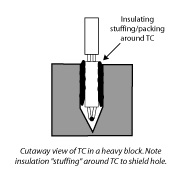 In this month’s article we will look at correct placement of TC’s in furnace brazing loads, and how, together with correct furnace heating/cooling rates, they can help to maximize uniformity of temperature throughout each brazing load and minimize any distortion of the components being brazed. By Dan Kay
Next Month: Next month let’s look at a question that often comes up in furnace brazing, namely, the role of braze-fillets at the edge of brazed joints, and what purpose they actually serve.