Product News & Training Archive

by Joseph
Vacuum Hardening High-Strength Steels: Oil Vs. Gas Quenching
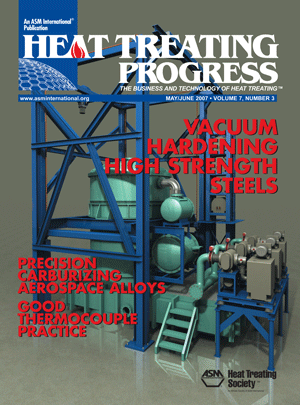 Vacuum heat treatment offers an alternative method to traditional salt-bath and controlledatmosphere furnace hardening techniques for high strength steels, such as AISI 4340M and 300M. However, heat treaters must be prudent when choosing between oil and gas quenching for vacuum hardening of high strength steels, because each process has its advantages and disadvantages. High strength steel alloys, such as 4340M, 300M, and others, are most commonly used in the manufacture of landing gear components. These alloys are hardened and tempered to produce ultimate tensile strengths exceeding 280 ksi (1,930 MPa). By Jeff Pritchard and Scott Rush – VAC AERO International Inc., Oakville, Ontario, Canada
by Joseph
Diffusion Brazing Technique for IN738
Transient liquid phase bonding, also known as diffusion brazing, is a metal joining process that produces a high quality bond through the isothermal solidification of a melting point depressant-rich interlayer.
by Joseph
Hot Zone Selection for Vacuum Brazing of Superalloys
 The Thermal Processing Divisions of VAC AERO International have provided repair services for damaged components from land-based and aerospace gas turbine engines. Engine manufacturers, operators, overhaul centers and commercial airlines are just a few of the customers that depend on these services. Many hot section engine components are fabricated from nickel-based superalloys. These materials cannot be repaired by traditional techniques, such as welding, without causing significant reductions in mechanical properties. As a result, VAC AERO developed proprietary vacuum brazing techniques to repair cracks, wear and other service-induced damage. By Jeff Pritchard – Vac Aero International Inc.
by Joseph
Preventive Maintenance Extends Hot-Zone Life
 Stretching the service life of a hot zone-one of the most expensive consumables in a vacuum furnace-is of prime importance to the furnace owner. Proper care and maintenance can slow down hot-zone deterioration, which directly translates to cost savings. Hot-zone service life is directly related to the type of heat treating process used in a vacuum furnace and to the severe thermal stresses imposed by continuous vacuum-furnace cycles. Distortion and contamination are the main factors causing a breakdown of hot-zone components. Distortion is inevitable because thermal cycling is inherent to the process. However, periodic inspection and remediation of hot-zone components together with thorough component cleaning can extend service life. By Bill Potts, Vac-Aero International Inc., Oakville, Ontario, Canada
by Joseph
Transient Liquid Phase (TLP) Bonding
TLP bonding is a metal joining process that yields a high quality bond at the interface of the materials to be jointed together. The bond is formed through the isothermal solidification of a melting point depressant (MPD) rich interlayer.
by Joseph
HVOF Coatings for Chrome Replacement on Airframe Components
Hard chromium plating has traditionally been used on aircraft airframe components to provide corrosion protection and wear resistance. Chromium plating has been identified by governmental regulatory agencies as a health hazard due to the presence of hexavalent chromium within the plating solutions. This has prompted major airframe and landing gear manufacturers to search for alternative processes to chromium plating which do not pose a health threat to the process operators. The leading candidate for hard chromium replacement is tungsten carbide coating applied by the HVOF (High Velocity Oxygen Fuel) thermal spray process. There are many practical considerations to account for when implementing a change of this magnitude.
by Joseph
Fluorocarbon Cleaning Process
All aviation gas turbine engines require regular overhaul to ensure continued safe operation. During engine overhaul, decisions must be made on whether to replace deteriorated individual parts and assemblies with new components, or to repair them.
by Joseph
New Considerations when Buying a Vacuum Furnace
With recent advances in technology, the vacuum furnace purchaser faces an array of new considerations when buying furnace equipment. Innovations in hot zone materials, control packages and quenching systems can offer many operating and performance improvements, but can also affect the price of the equipment.
by Joseph
Important Considerations for Establishing a New Vacuum Heat Treating Capability
 Many companies that outsource vacuum heat treating must eventually decide if they would be better served by setting up this capability in-house. Establishing a new heat treating capability requires a significant capital investment in furnace equipment. However, there are other costs and issues that should be considered when assessing the business case for such a project. VAC AERO has prepared a few brief guidelines to assist customers who are not well-experienced in heat treating but are assessing the need to establish a heat treating capability. READ MORE (Download PDF of this article)