Vacuum Brazing with Dan Kay Archive

by Joseph
Thermocouples in Furnace Brazing – Part 1
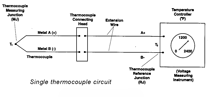 Proper temperature control within each furnace brazing cycle is essential. It will not only insure proper brazing filler metal (BFM) flow, but can also prevent part distortion. To accomplish this, multiple thermocouples (or “TC’s” as they are often called) need to be placed in strategic positions within each furnace load. By Dan Kay
In this first of two articles on TC’s and their use in brazing, I’d like to briefly look at what TC’s are, and the types commonly available for use in brazing furnaces today (much more exhaustive discussions about TC’s can be found on the websites of a number of thermocouple manufacturers and suppliers). In next month’s article, I’ll describe the actual use and placement of these TC’s in different brazing furnace cycles.
Next Month we will look at correct placement of TC’s in furnace brazing loads, and how, together with correct furnace heating/cooling rates, they can help to maximize uniformity of temperature throughout each brazing load and minimize any distortion of components that are being brazed together.
by Joseph
Differential Metal Expansion – Part 2
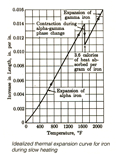 In this month’s article on differential expansion of metals, I will explore the effect that thermal expansion has on joint clearance, and thus, on brazed joint strength and quality of 1018 carbon-steel. For anyone doing high-temperature brazing of carbon-steel components using a high-temperature brazing filler metal (BFM) such as pure copper, it’s an important concept, and needs to be understood. By Dan Kay
Next Month: In my next article, we’ll take a closer look at thermocouples — which kind you should use, and how it should be connected to the parts in your furnace load, where they should be placed in the furnace, etc.
by Joseph
Differential Metal Expansion – Part 1
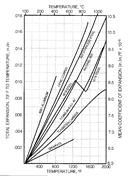
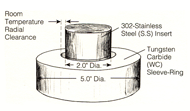 In this article I will explore the effect that thermal expansion has on joint clearance, and thus, on brazed joint strength and quality. It’s an important concept, and although it is well known in the brazing world, many folks today still do not take this topic seriously enough when designing brazed assemblies. This article is based on one I wrote many years ago for an in-house brazing publication at a brazing filler metal supplier, and will be written in two parts. Next month’s segment will look more closely at polymorphic metals, such as carbon steels, and will attempt to explain why they exhibit their very strange thermal expansion curves. By Dan Kay
Next Month: In my next article, I’ll examine the thermal expansion curve for 1018 carbon steel to see why there are strange “reversals” in the thermal expansion curve for that alloy (and for similar metals).
by Joseph
Voids in Brazed Joints
 Brazers commonly encounter voids in brazed joints and often wonder where they come from and how to avoid them in future brazements. Some common sources of voids in braze joints are: surface contamination, base metal and brazing filler-metal (BFM) constituents, brazing methods/temperatures used and poor joint fitup. The first three items listed above can often result in gas bubbles being formed in brazed joints. Such gas-bubble voids will usually try to form in spherical shape as they move through a joint. The “rounded” edges of such bubble-voids can often be clearly seen in cross-section photomicrographs of brazed joints, especially under high magnification. The inside surfaces of a bubble-void will often appear “clean” or “shiny” as well. By Dan Kay
by Joseph
Braze Joint Design Considerations – Part 2
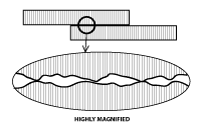 For successful brazing to occur, the joints to be brazed have to be designed properly, and then properly manufactured to attain and maintain those shapes and dimensions. This second article looks at joint clearance considerations in more detail. Joint clearances must be close together and parallel. The amount of clearance between the faying surfaces (the mating surfaces inside a joint being brazed) should ideally be kept small, on the order of about 0.000″– 0.002″ (0.000-0.050 mm) total, so that capillary action can most effectively pull the molten brazing filler metal (BFM) completely into and throughout a braze-joint. By Dan Kay
Next Month: In next month’s article we’ll address some additional factors in joint design, specifically the topic of “differential metal expansion”. All metals expand at different rates when heated, and since braze-joint clearances are calculated based on expected clearances at brazing temperature, we need to know how to properly optimize brazing of different metals in the same assembly.
by Joseph
Braze Joint Design Considerations
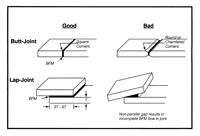 There are basically two types of joint designs used in brazing: butt-joints and lap-joints. All other joint designs are modifications of these two. There are a number of important considerations when designing such joints in order to insure proper service life. This article looks at just a few of those considerations. By Dan Kay
Next Month: Next month I’ll discuss the issue of braze gap clearance for some different base-metal and brazing filler metal (BFM) combinations, and how that affects joint strength and hermeticity. In succeeding months we’ll address issues such as dissimilar metal brazing and how that affects joint design.
by Joseph
How to Determine Braze Gap-Clearances for Your Furnace
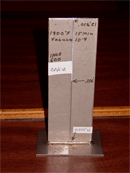 Good brazing depends on the ability of capillary action to draw the molten brazing filler metal (BFM) in all directions throughout the joint being brazed, either vertically or horizontally. A unique Vertical Capillary Test Specimen (VCTS) was developed to help brazers find out the maximum gap-thicknesses that capillary action can fill in their particular brazing furnaces. By Dan Kay
Next Month: Next month I’ll discuss some important design issues regarding braze gap clearances and configurations, and in succeeding months we’ll address issues of dissimilar metal brazing, and joint strength and its optimization in more detail.
by Joseph
Are the use of dead-weights for fixturing a recommended practice?
 The effective use of “metallurgical fixturing”, instead of a lot of dead-weights, to effectively “load” parts with enough pressure to keep braze joints close together for effective brazing is described in detail.
The use of heavy weights on top of parts being brazed is a common practice. Its purpose is to load the top of the assembly with enough weight so as to insure that the components of the assembly will be pressed together sufficiently to keep the joints from opening up during furnace brazing. This should then insure that good capillary action of the brazing filler metal (BFM) into those joints will occur during the furnace cycle. But in real-life brazing, such use of dead-weights can lead to extended cycle times, and fail to so what it was supposed to do. This article explains why. By Dan Kay
by Joseph
Selecting Brazing Fixture Materials
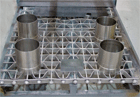 Which base-metal should I use for braze fixturing so that it will last the longest?
This question is not an uncommon one. Although I have never personally seen any kind of chart showing an “expected life” for fixture materials, it is important that people understand that there are a number of factors that will control the “life expectancy” of any fixturing material used in brazing, and all of these factors relate to the service conditions that the fixtures will encounter during the brazing process. By Dan Kay.
In August’s article, I’ll address the commonly used method of adding a lot of “dead weight” onto parts in an attempt to keep them flat during brazing!
by Joseph
Partial Pressure Brazing
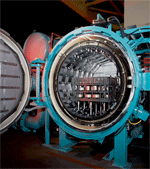 As mentioned in previous articles, more and more brazing shops are using vacuum furnaces. These furnaces are quite complex, offering more options for heating, cooling, partial pressure, or multi-bar pressure (pressure capabilities above one atmosphere) for high-speed cooling.
The overall effectiveness of the equipment, however, still lies with the people who program and run the furnaces. Figure 1 (below) shows a series of vapor pressure curves for a number of common metallic elements. Each curve shows the melting point of the element (indicated by a small circle along the curve) and, where the curve crosses the dotted line across the top of the chart, its approximate boiling point (where it wants to turn to a gas) at one standard atmosphere. By Dan Kay