Product News & Training Archive

by Joseph
Maintenance procedures for vacuum furnaces
 Maintenance procedures and safe working conditions are essential in maintaining vacuum furnaces as is proper preparation of components to be heat treated prior to charging to the furnace.
VAC AERO International operates more than a dozen vacuum furnaces in its own heat treating facilities. In addition, it has manufactured hundreds of vacuum furnaces for sale to the global market. Through these activities, the company has gained extensive experience in the care and maintenance of vacuum furnace equipment.
by Joseph
Energy Optimization in the Heat-Treat Department
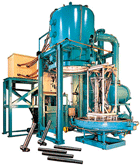 Savings can be achieved by improving energy efficiency, which reduces the amount of electricity consumed. Savings can also be easily achieved by making slight changes to the timing of this consumption, thereby reducing the peak electricity demand.
Large heat-treating facilities are substantial electricity consumers. Specializing in vacuum heat treating and brazing for aerospace and other high-technology industries, VAC AERO International’s Oakville, Ontario, plant operates more than 24 vacuum, air and controlled-atmosphere furnaces. Included are three very large vacuum oil-quench furnaces, all of which result in substantial electricity consumption. Indeed, the company’s electricity costs have increased by more than 30% in recent years, thereby driving an effort to find lower-cost solutions. by Mark Passalent
by Joseph
Welding of High Strength Steel Landing Gear Components
 The assembly is a five-piece, tubular structure manufactured entirely from 4330V steel. It consists of a hollow tube approximately 1500mm long by 120mm in diameter, two fittings (upper and lower) that are TIG welded to each end of the tube and two backing rings that bridge the gaps between the fittings and the tube during the welding operation. For many years, VAC AERO has been performing welding and heat treating operations on a landing gear component for a popular turboprop aircraft. Because of the part design, the welding operation in particular is complex and challenging and often involves substantial re-work. In order to minimize the rate of re-work…read more. by Jeff Pritchard CEO, VAC AERO International Inc.
by Joseph
Coating Gas Turbine Engine Blades Using HVOF
 |
In recent years, the operating temperatures of land-based gas turbine engines have increased to improve efficiency. As a result, greater demands are placed on the materials used in the manufacture of the engine components.
In particular, hot section turbine blades must function in a very severe operating environment. The blades are usually manufactured from advanced nickel-based superalloys but these materials on their own are still not durable enough. To enhance their durability, they are protected from hot corrosion and high temperature oxidation through the use of special coatings. The coatings form adherent oxide layers that inhibit the blade material from directly interacting with potentially damaging elements within the combustion gases like oxygen, sulphur and other contaminants. A popular approach involves coating the blades with an MCrAlY bond coat topped with a thermal barrier coating (TBC) overlay. READ MORE
by Joseph
Maintenance Procedures for Vacuum Furnaces Part 4 – Leak Rate Testing
 |
Vacuum level as indicated by vacuum gauge readings is not always a true indication of the actual conditions within a vacuum furnace. It is possible to have two identical furnaces operating at the same pressure but producing entirely different results on heat treating.
The reason for this can be explained by the relative leak tightness or leak rate of each furnace. Most furnaces are equipped with pumping systems sufficient to overcome reasonably significant leaks. On the furnace with the higher leak rate, air would be leaking continuously into the furnace resulting in a higher residual oxygen content than in the leak tight furnace. The higher oxygen content would adversely affect the heat treating results. Therefore, leak rate checks as prescribed by the furnace manufacturer should be performed at regular intervals to prevent this problem. READ MORE
This is the last in a series of four articles on Vacuum Furnace Maintenance. (read part 1) / (read part 2) / (read part 3)
by Joseph
Maintenance Procedures for Vacuum Furnaces Part 3 – Minimizing Outgassing
|
Whenever the door to a vacuum furnace chamber is open, humidity from the air will enter the chamber and condense in a very thin film on the chamber walls or be absorbed into the hot zone materials.
When the chamber is subsequently evacuated (before heating) and the furnace internals are exposed to this lower pressure, “outgassing” of the entrapped moisture will occur. If sufficient moisture has been entrapped (such as in very humid environments), the outgassing effect will slow the pumpdown process and may even give the appearance of a malfunction in the pumping system. Eventually, the outgassed moisture will be pulled out of the chamber by the pumping system and evacuation rates will improve. This same effect will be apparent when oily or contaminated workloads are placed in the furnace. It may be more pronounced in furnaces with graphite-based hot zone insulation materials. READ MORE
This is the third in a series of four articles on Vacuum Furnace Maintenance. (read part 1) / (read part 2)
by Joseph
Vacuum Brazing Techniques Part 3 – Preparation for Vacuum Brazing
 |
Clean, oxide-free surfaces are essential to achieve sound brazed joints.
Uniform capillary action will occur only when all grease, oil, dirt and oxides have been removed from both the braze alloy and base metal prior to brazing. The length of time that cleaning remains effective depends on the material involved, atmospheric conditions, storage techniques and the amount of handling that may be involved. It is recommended that brazing be performed as soon as possible after the material has been cleaned. The selection of a cleaning technique depends on the nature of the contaminant, the base metals involved and the joint design. The same cleaning practices used for vacuum heat treating (ie. manual cleaning, vapour degreasing, etc.) are applicable to vacuum brazing. READ MORE
This is the third in a series of four articles on Vacuum Brazing Tecniques. (read part 1) / (read part 2)
by Joseph
Hot Zone Repair, Re-build and Retrofit
Besides catastrophic damage due to mechanical abuse, eutectic melting or braze alloy spillage, vacuum furnace hot zones will deteriorate over time as a result of the repeated thermal cycling to which they are exposed.

The life of a hot zone may vary widely depending on operating conditions. Furnaces that are operated constantly in aggressive environments (eg. sintering) or consistently at temperatures over 1370ºC (2500ºF) may require fairly major hot zone maintenance as often as once per year. Hot zones in furnaces used for standard heat treating operations can be expected to last from 5 to 7 years. READ MORE
by Joseph
Maintenance Procedures for Vacuum Furnaces Part 1 – Safety
|
As with any piece of equipment, proper maintenance at regular intervals is essential for long service life and trouble free operation.
The mechanical components in a vacuum furnace require standard maintenance practices (ie. cleaning, lubrication, etc.). However, successful use of a vacuum furnace depends on the purity and reliability of its vacuum. Additional maintenance activities are required to ensure good vacuum levels in the system. Leaks in joints and contamination of furnace internals will greatly affect operating vacuum levels and the quality of the processing. Leaks are the most time-consuming and troublesome of the maintenance items. READ MORE
This is the first in a series of four articles on Vacuum Furnace Maintenance due to appear over the next three months.
by Joseph
Maintenance Procedures for Vacuum Furnaces Part 2 – Vacuum Seals
|
During construction, all welded joints in a vacuum furnace are inspected for hermetic integrity and should remain intact for the life of the furnace.
However, there are also a number of demountable connections that can be separated and reconnected for component changing or repair access reasons. These connections are generally sealed with a gasket sandwiched between two flanges. Though different gasket materials are used depending on the vacuum level required, most seals in a standard vacuum furnace incorporate an o-ring made of natural or synthetic rubber. Buna-N, silicone and Viton o-rings are readily available in many sizes. READ MORE
This is the second in a series of four articles on Vacuum Furnace Maintenance. (read part 1)